Have you ever read a description of a character doing something in a story and felt like something was a bit off?
Human beings are not only very sensitized to how other humans behave, but the way our sensory system works means that in most circumstances people respond to an event or stimulus in expected ways.
Let me give you an example.
Let’s say a bee stung you. (The Stimulus) Which are you more likely to do? (The Response)
- Tell your companion that a bee just stung you and they better go home. Yell yeow and slap your hand over the sting. Flinch. Feel adrenaline surge through your body. Think: Oh I got stung by a bee.
- Adrenaline surges through your body. You flinch and yell yeow. You slap your hand over the sting. You think “Oh I got stung by a bee.” Finally, you tell your companion that a bee stung you and they’d better go home.
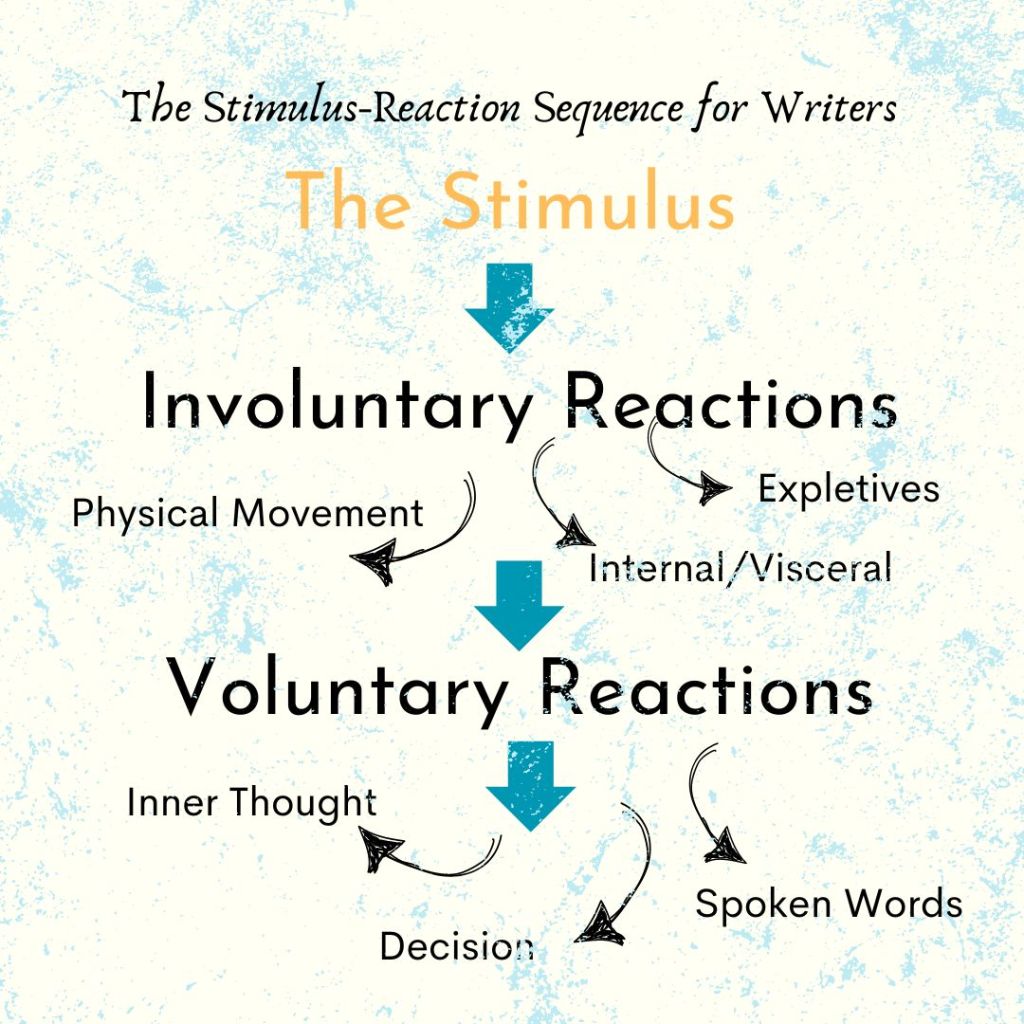
Both sentences describe the same event, but the first one sounds awkward. That’s because when we experience a surprising pain or other sensory experience, our first few reactions are instinctual. These reflexes include all or some of the following:
- An involuntary movement: We feel the pain of the sting, and we react with an involuntary reflex movement, such as jerking away or flinching.
- An involuntary verbalization or expletive: We make a sound, such as a grunt, cry, or shout.
- An involuntary visceral reaction: Our body prepares for danger. This includes our adrenaline building, our pulse rising, ringing in our ears, pounding in our heads, and so on.
These are followed by voluntary reactions. These include:
- Thinking: Puzzling out what happened.
- Deciding: Making a decision.
- Speaking: Putting the experience into words or sharing with others.
Writing a Stimulus-Action Sequence
Using the stimulus-reaction sequence to describe our character’s actions in a story is a powerful way to add reality to a scene, even when the character is inhuman or a sentient animal.
Step 1. Describe the stimulus – This is an event that the character experiences through their senses. Here is a list of possible events.
- Being injured in some way – cut, hit, stung, stabbed, bitten, drugged, falling, and anything that causes bodily damage.
- Receiving pleasure in some way – being warmed, rubs, hugs, comfort, etc.
- Seeing, touching, hearing, tasting, or smelling something – eating something tasty or disgusting, viewing something horrid or beautiful, smelling something noxious or fragrant, hearing an explosion or a bird, touching warm sand or ice, etc.
Step 2: Describe the character’s reaction to that occurrence using this order:
- Involuntary reflex reaction or physical movement like when you jump when you hear an explosion. It can also be an expletive like Ouch or Uh.
- Visceral reaction (this a bodily reaction – how the character’s head, heart, stomach, pulse feel based on the emotional reaction to the event,
- The character’s inner thought about the event
- What the character says out loud
- The character’s decision on what to do as a result or what physical action they take.
Now you don’t need to include every one of these reactions, But in the beginning, it is a good idea to write them all out in a list. Later you can cut and smooth the prose.
Example #1
STIMULUS: The broken edge of glass cut through her thigh
- She yanked her leg away. (Involuntary action)
- Blood poured out.(Involuntary visceral)
- “Ooh.” (Involuntary sound)
- The leg trembled. (Involuntary movement)
- This is bad. (Inner thought)
- I need help. (Decision)
- “Help me.” (Verbalize)
Sentences edited
The broken edge of glass sliced through her thigh. Blood poured onto the ground. “Ooh!” Leg trembling, she turned it one way then another. This was bad She was losing too much blood. It need to be stopped before she fainted. Despite the empty hopelessness of it, she screamed, “Help me.”
Example #2
The STIMULUS: A loud crash
- I jump up. (Involuntary action)
- My heart races. (Involuntary visceral reaction)
- Was someone in the house with me? (Inner thought)
- I look over my shoulder. (Voluntary Movement)
- I take a step toward the door. (Decision)
- “Anyone there?” I squeak. (Verbalize)
Crash. I jumped up, my heart racing. Was there someone in the house with me? I looked over my shoulder and took a step toward the door.
“Anyone there?” I squeak.
Putting the Stimulus-Reaction Sequence to Use
Once you know this sequence, you can use it in these ways:
- When drafting a description of a character reacting to some stimulus.
- Write a series of Stimulus-Reaction Sequences to build an action scene. It works particularly well for fights, rescues, and love scenes.
- During revision, check that actions follow the sequence.
Summary
The Stimulus-Reaction Sequence is a handy tool for writing logically organized descriptions of character actions. Here is a simple chart for you to clip and use.
Share an action paragraph that you have written that uses the Stimulus-Action Sequence.
Discover more from ZARA WEST'S JOURNAL
Subscribe to get the latest posts sent to your email.

Thanks for your informative posting, Zara. As I write short paras my example is four paras giving the heroine’s response to an odd situation. It is an extract from my book, ‘Broome Enigma’ by Meryl Brown Tobin, The Wild Rose Press, NY, 2023, p109.
At the holiday house, the curtains were drawn. Jodie frowned. Quickly she unlocked the downstairs door, went in, locked the door behind her, and ran up the inside stairs to the living-room. “Marc!” she called. “Marc, I’m back!”
Upstairs was in pitch blackness. Jodie’s body tensed. Leaving on the lights over the stairs, she turned on the lights in the living room. Warily she walked in. “Marc, are you there, Marc?”
The hairs on the back of her neck stood up. She put down her overnight bag and handbag and stared into the blackness. “Marc, it’s me, Jodie.”
She walked to a small table nearby and picked up an empty vase. Gripping it firmly, she slowly pushed open Marc’s bedroom door and switched on his light. “Marc…?” Her voice stuck in her throat—his bed was empty though slept in.
LikeLike
Thank you for sharing, Meryl. I loved your book!
LikeLike