
Planning a trip? Love little notebooks? While I am a big fan of technology (I am currently writing a novel in Notion), there is something magical about capturing one’s thoughts with only pen and paper. In fact, I firmly believe that my ideas flow better when handwritten.
The research study “The Neuroscience Behind Writing: Handwriting vs. Typing—Who Wins the Battle?” supports this belief. They found that while typing adds speed and convenience to the writing process, writing by hand forces the brain to process information more actively, improving memory retention and understanding.
A jot note journal builds on that process. It is a place to capture ideas as they strike you and provides a place to play around with them. Unlike a general journal, a jot note journal focuses on one piece of writing. It could be a novel or a non-fiction work. It could be a short story or a textbook. It is for whatever your work in progress (WIP) is.
By limiting the journal’s focus to only one work, you will train your mind to think only about that piece of writing when you open its pages.
Now, you could just as easily jot all this information down on scraps of paper. In fact, I suggest doing just that in my book Fast Draft Your Manuscript. However, recently I’ve been finding too many paper scraps littering my writing zone.
So, for the upcoming addition to my Tide Harbor series, Trapped by the Tide, I have designed a “jot note journal” to use as I draft. To do so, I am borrowing practices from the original Bullet Journaling Method while adding my own take on the layout and components.
I hope this will inspire those who like to leave the keyboard and screen behind every once in a while. Here’s my method. Feel free to borrow and adapt this system to best meet your unique needs.
MATERIALS
You need a journal, obviously. But it can take many forms. It can be any size – 5″ by 8″, 6″ by 9″, a standard 8″ by 10.5″ notebook, plain or fancy. [Alternatively, you can print out the journal pages I have created for you and staple them together, or hole punch them and insert them in a binder.]
- And a pen or pencil that is a pleasure to write with. (I like a fountain pen.)
- Optional – Colored pencils and/or markers
- Optional – Sticky notes to mark off the different sections.
STRUCTURE
Create your cover page and title & date page. Now start your journal.
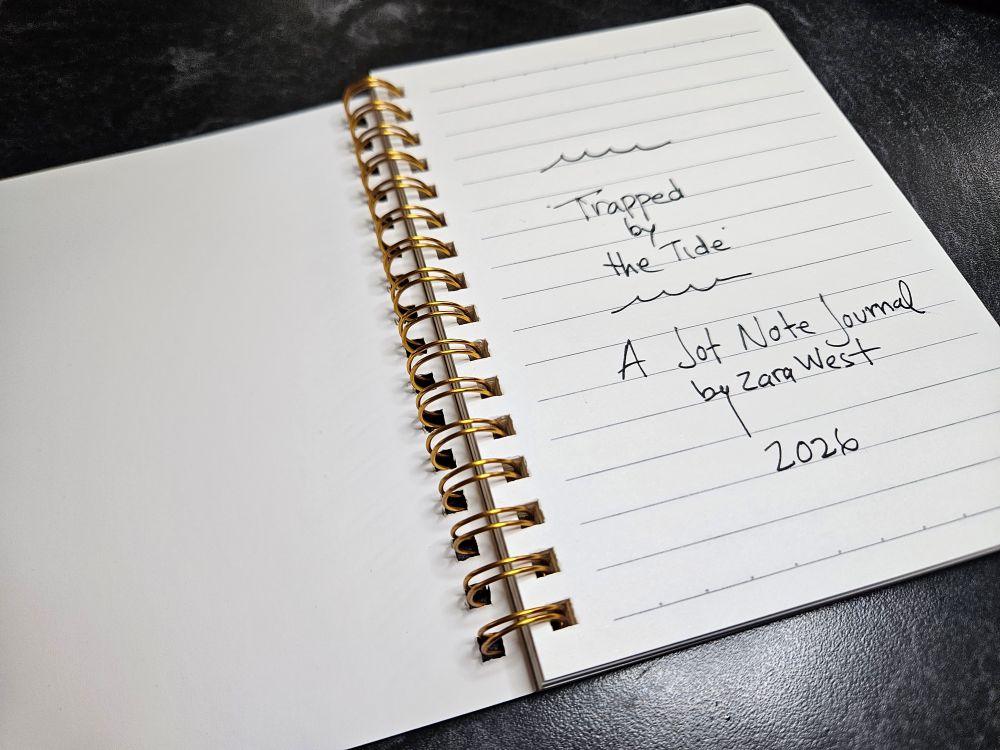
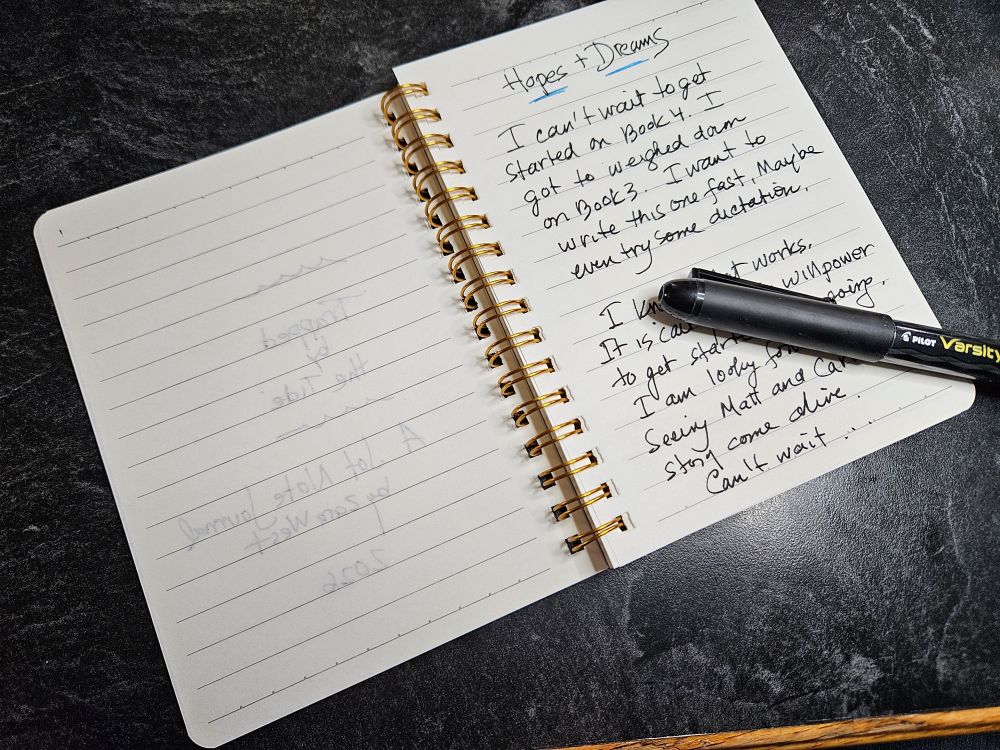
Section 1 Hopes & Dreams
Knowing your inner motivation for writing this work will give you the impetus to get started and stick with it. Use this opening section of your Jot Note Journal to hone in on the internal emotions that impel you to write this WIP, as well as the external pressures, such as finances or deadlines, that add stress. Think about how you envision the final work. Describe how it will feel when you complete it. Use as many pages as you need for this section. Leave a few blank pages at the end so you can go back and add thoughts as they occur.
Section 2 Writing Goals
I find that planning out all the potential writing tasks and goals is quickest and easiest done on paper. After all, once you finish this WIP, you will rarely refer to these again, so why have them take up space on your computer?
In this section, play around with possible time frames for writing this work, such as how long you plan to spend on it. How often will you work on it? Will you have a strict deadline, a daily word count, or are you flexible? Will you be trying something new, such as fast drafting or using dictation?
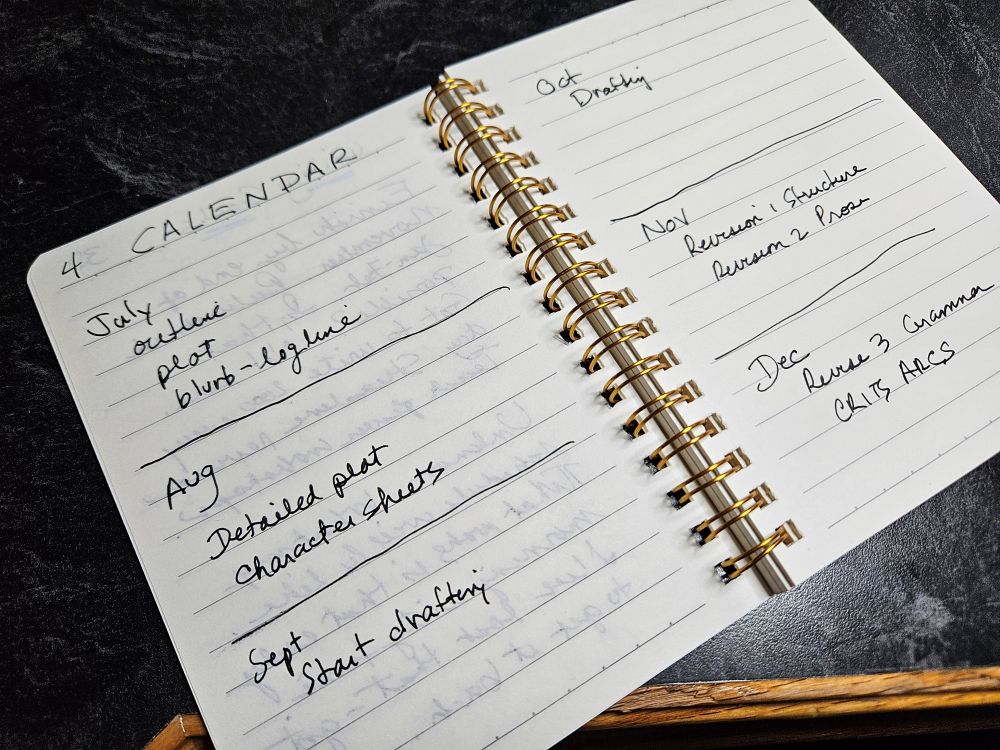
Section 3 Calendar
If you wish, create a simple calendar by dividing the next few pages into thirds or fourths, one for each week or month of planned writing time, and then lay out the activities that might occur in each time period.
Section 4 The Daily Record
The Daily Record is where you will record your writing progress. It can be as simple or detailed as you wish. This section starts after the goals and calendar and is always on the LEFT pages of the journal. Here is where you can record all the things you want to keep track of each time you write. Here is what I like to record, but feel free to add or subtract to match your own progress system.
- Date
- WIP page numbers
- Word count
- Time spent writing.
- Other writing activities, such as sprints and book-related appointments.
Note: I have used and recommended word counters, but I always seem to return to a handwritten version.
Section 5 Writing Notes
This is where you record everything related to the actual WIP that occurs on that date. This section is on the corresponding RIGHT side of the page. If your notes spill over to the next page on the left, that’s okay. Write until done. Then, the following day, start your Daily Record on the next BLANK LEFT page.
Your notes can be anything that does not need to be kept forever. It’s a place for your mind to play and your hand to doodle. A place to use quick visual tools. Here are some ideas.
- Brainstorms
- Story Notes
- Vocabulary wordstorms
- Plot ideas
- Inspiring quotes
- Quick character sketches
- Troublesome spots
- Sketches, diagrams, or doodles
- Pasted in clippings, pics, etc.)
- Things to go back and add or/fix
Section 6 Index
While you can flip back through the journal to find past notes, consider making an index. It takes very little extra time. Number the pages as you go. To create the index: Start at the back of the journal. Add entries and page numbers as needed.
THIS JOURNAL IS YOUR JOURNAL
Remember, the Jot Note Journal is for you alone. Nobody else ever needs to see it, and you can throw it away when you are done. Feel free to add other sections or information. Be wild. Be creative. It can be sloppy, colorful, outrageous, plain, or neat as a pin. It is another tool for your writer’s Toolbox, and I would love to hear your thoughts about keeping one.
Download Your Free Jot Note Journal Pages Here
Let’s talk
Will you be trying a jot note journal? Do you already use something similar?
Discover more from ZARA WEST'S JOURNAL
Subscribe to get the latest posts sent to your email.

A lot of this strikes me as a good idea. Am I that organized? About my part time job of auditing a law firm’s trust account, yes. About writing, not necessarily (I’m a pantser). But I have plenty of unused notebooks to experiment with…
LikeLike